
Atlas HXM Global Workforce Indexes Briefing — Q4 2026. Europe dominates the top of the Atlas HXM Visa Mobility Index (AVMI). It does not dominate the Atlas HXM Hiring Destination Index (AHDI), however, and the gap between the two is where mobility plans go wrong.
Key Findings
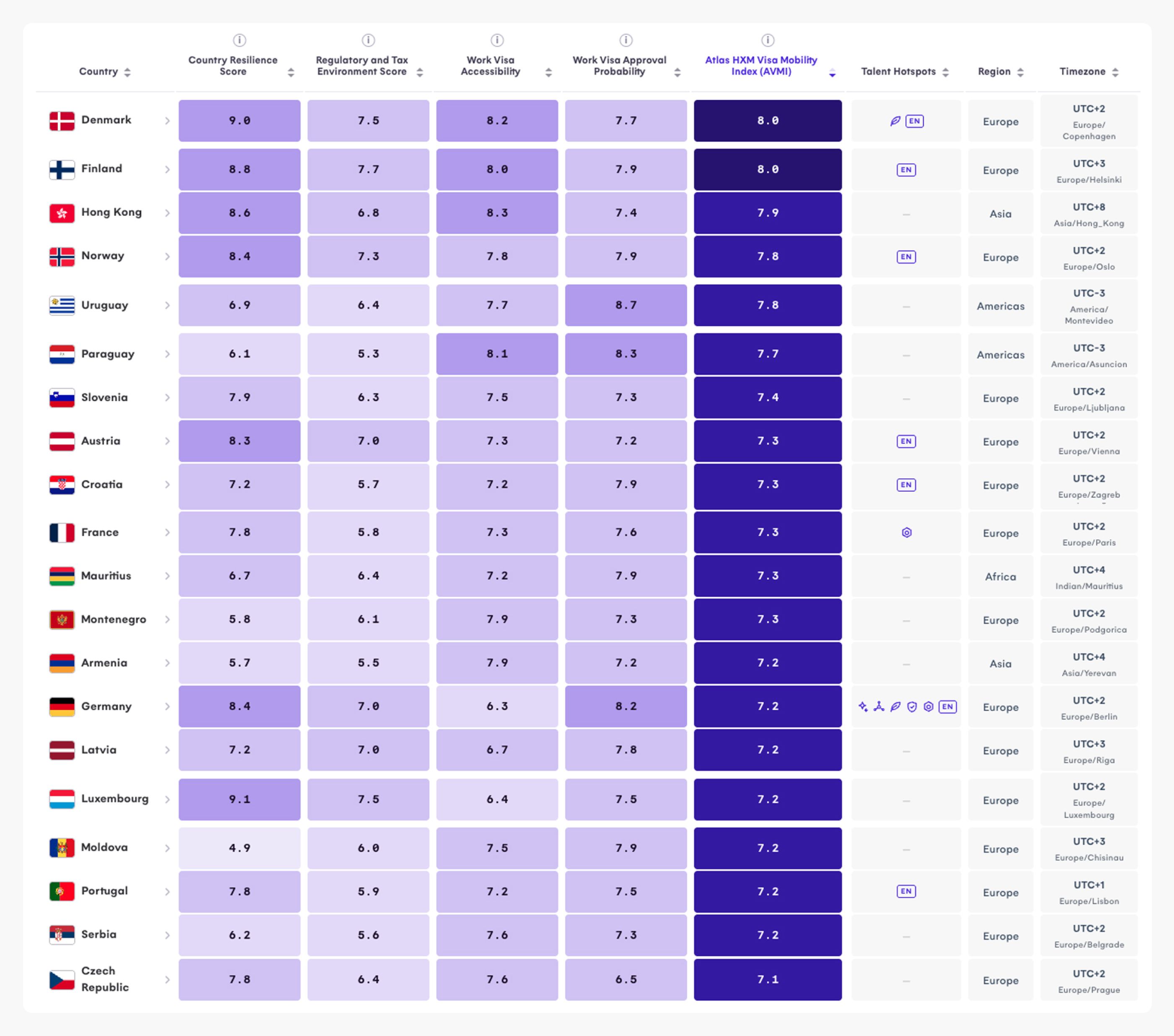
Twelve of the top 25 countries on the Atlas HXM Visa Mobility Index are EU members. Four more are non-EU European neighbors.
A country's visa score tells you very little about its hiring score. Across the countries scored on both, the two correlate at just 0.32, which is considered low.
Hungary, Lithuania and Greece score 2.3, 2.4 and 4.4 out of 10 on visa accessibility — while approving applications at 7.9, 7.5 and 7.3 out of 10. The obstacle is the process, not refusal.
France sits in the top ten for visa mobility and in the bottom third for hiring.
Europe Opens Its Doors to Talent
Europe is one of the easiest regions in the world to move people into. As a place to hire them though, it looks very different.
Denmark and Finland lead the Atlas HXM Visa Mobility Index (AVMI) worldwide, with France also in the top ten. Twelve of the top 25 are EU members — Denmark, Finland, Slovenia, Austria, Croatia, France, Germany, Latvia, Luxembourg, Portugal, the Czech Republic and Spain — and four more are non-EU European neighbors: Norway, Montenegro, Moldova and Serbia.
The AVMI scores the work visa and permit routes open to people coming from outside a country, so within the EU it measures access for non-EU nationals rather than free movement between member states. For a US or UK employer moving an existing team member into Europe, that is the relevant question and shows that much of Europe offers a more accessible and predictable route compared to the rest of the world.
The Visa Pillars Disagree More Often Than Expected
The AVMI is built from four weighted pillars: Country Resilience (10%), Regulatory and Tax Environment (10%), Work Visa Accessibility (45%) and Work Visa Approval Probability (35%).
The last two carry most of the weight, and they are reported separately because they frequently point in opposite directions.
Accessibility measures how much documentation, process and elapsed time a typical case demands. Approval probability measures how likely that case is to succeed once submitted. A country can publish a straightforward permit and still refuse a large share of applications. Another can run a demanding process that approves nearly everyone who completes it.
Three European countries show the second pattern clearly. Hungary scores 2.3 on accessibility against 7.9 on approval. Lithuania scores 2.4 against 7.5. Greece scores 4.4 against 7.3. All three approve applications at rates in line with the rest of the region, but what separates them from their neighbors is the volume of process required to get there.
The practical consequence is that these are not high-risk markets for mobility. They are slow ones. A team that plans for refusal risk in Hungary is preparing for the wrong problem, while the real one — a start date that moves because documentation takes longer than the hiring timeline allowed — goes unplanned for.
Visa Access Tells You Nothing About Hiring Conditions
It would be reasonable to assume the two travel together: a country that makes it easy to bring someone in probably makes it easy to employ them. The data does not support that. In fact, Europe's advantages all but disappears on hiring.
Across the countries scored on both indexes, visa mobility and hiring conditions correlate at 0.32 — a positive relationship, but a weak one. A country's score on one question barely explains its score on the other, which is why strong performers on one are routinely mid-table on the other.
France is the clearest illustration. It sits in the top ten on the AVMI and in the bottom third of the Atlas HXM Hiring Destination Index (AHDI), which scores how straightforward it is to employ people directly, what employment costs, and how stable the operating environment is. On labor market regulations alone, France is among the lowest-scoring countries in the index. Moving someone to Paris is comparatively easy. Employing, managing and — if it comes to it — exiting them is not.
The two decisions are usually made weeks apart by different people. The mobility team assesses whether the person can get there. The HR and legal teams assess what employing them involves. Neither question answers the other.
Explore The Data
The Atlas HXM Visa Mobility Index scores 136 countries and is free to explore, with no registration and no paywall. It sits alongside the Atlas HXM Hiring Destination Index (AHDI) and the Atlas HXM Contractor Compliance Index (ACCI).
These indexes combine Atlas HXM's own operational data — real processing times, approval outcomes and documentation complexity from cases Atlas HXM has run — with established public sources including the World Bank, the OECD, the International Labour Organization, the European Commission, the IMF and national immigration and labor authorities. Scores are absolute rather than relative. The full methodology is published alongside each index.